

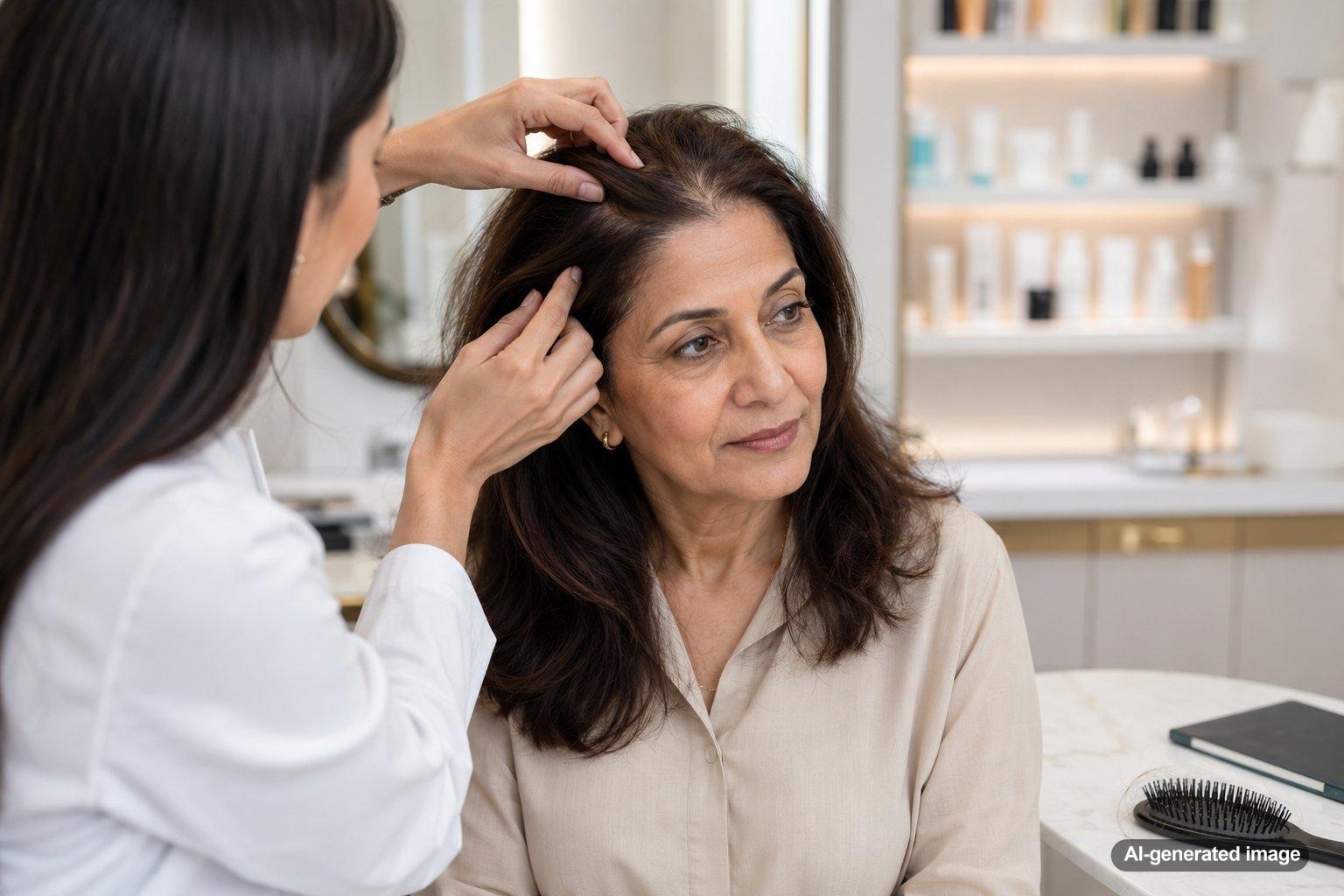
Finding more hair in your brush, shower drain, or around the bathroom can feel unsettling. The most important first step is understanding whether you are seeing temporary shedding, true hair loss, or a mix of both.
In simple terms, hair shedding usually means more hairs are entering the resting phase and falling out than usual. Hair loss more often means something is interfering with the follicle’s ability to keep producing healthy hair. A board-certified dermatologist can evaluate the pattern, scalp, medical history, and possible triggers so the next step is thoughtful rather than rushed.
Quick answer
- Hair shedding is usually a higher-than-usual number of hairs falling out, often diffusely across the scalp.
- Hair loss usually means less hair is growing back, hair is thinning in a pattern, or patches are developing.
- Shedding can be associated with stress, illness, surgery, nutrition changes, childbirth, medication changes, or hormonal shifts.
- Hair loss can be associated with genetics, inflammation, autoimmune conditions, traction, scalp conditions, medications, or other medical factors.
- If you are unsure, it is worth getting checked, especially if the change is sudden, patchy, painful, itchy, or progressive.
| Feature | Hair shedding | Hair loss |
|---|---|---|
| What you may notice | More hairs coming out in the shower, brush, pillow, or hands | Thinner density, widening part, receding areas, or bald patches |
| Pattern | Often diffuse across the scalp | Can be patterned, patchy, or diffuse depending on the cause |
| Key question | Why are more hairs cycling out right now? | Why are follicles producing less hair or stopping growth? |
What hair shedding means
Hair naturally cycles through growth, transition, resting, and shedding phases. Shedding becomes more noticeable when a larger number of hairs move into the resting phase around the same time. This can make the amount of hair falling out look dramatic, even when the scalp still has overall coverage.
One common form of excessive shedding is telogen effluvium. It can be associated with physical or emotional stress, illness, surgery, childbirth, sudden hormonal changes, nutrition shifts, or certain medications. The trigger is not always obvious, and timing can be delayed, which is why a careful history matters.
What hair loss means
Hair loss is different because it often involves reduced growth, follicle miniaturization, inflammation, scarring, traction, or patchy loss. Instead of simply seeing more hairs fall out, many people notice that the hair does not feel as dense, the part looks wider, the hairline changes, or a specific area becomes thinner.
Common forms include androgenetic hair loss, alopecia areata, traction-related loss, inflammatory scalp conditions, and medication- or illness-associated changes. Some causes are temporary, while others benefit from early evaluation because treatment choices depend on the diagnosis.
Common causes or triggers
- Recent illness, fever, surgery, or significant physical stress
- Emotional stress, major life changes, or disrupted sleep
- Childbirth, menopause, thyroid changes, or other hormonal shifts
- Low iron, restrictive dieting, rapid weight change, or nutrition gaps
- Family history of patterned hair thinning
- Tight hairstyles, extensions, or repeated tension on the scalp
- Scalp symptoms such as itching, scaling, tenderness, redness, or flaking
- Medication changes or treatments that may affect the hair cycle
What you can do at home
At-home steps are best kept gentle and conservative. Avoid aggressively brushing, tight hairstyles, harsh chemical processing, or repeated heat styling while you are trying to understand what is happening. Use a mild shampoo, condition the hair to reduce breakage, and handle wet hair carefully.
It can also help to write down when the shedding started, any recent illnesses or procedures, medication changes, nutrition changes, and whether the change is diffuse, patchy, or patterned. Photos of your part line, temples, crown, and any affected areas can help your dermatologist compare changes over time.
Professional options
A dermatologist can examine the scalp, review your medical history, consider lab testing when appropriate, and look for signs that point toward shedding, patterned thinning, inflammation, traction, infection, autoimmune activity, or another cause. Treatment may involve addressing an underlying trigger, changing hair practices, topical therapies, prescription options, in-office treatments, or monitoring when that is the safest approach.
At Waverly DermSpa, we offer PRFM for Hair Loss and can help you understand whether it may be appropriate.
When to see a dermatologist
Consider scheduling an evaluation if shedding is sudden, heavy, or persistent, or if you notice bald patches, a widening part, scalp pain, itching, burning, redness, scaling, sores, broken hairs, eyebrow or eyelash loss, or hair loss after starting a new medication. It is also worth getting checked if hair changes are affecting your confidence or if you simply cannot tell whether it is shedding or hair loss.
FAQ
Is shedding always a sign of a serious problem?
No. Hair shedding can happen after common triggers such as stress, illness, childbirth, or hormonal shifts. Still, a dermatologist can help identify whether it is expected shedding, true hair loss, or both.
Can hair shedding and hair loss happen at the same time?
Yes. Some people experience increased shedding on top of patterned thinning or another hair loss condition. That is one reason a scalp exam and history can be helpful.
How can I tell if my part is widening?
Try taking photos in the same lighting, from the same angle, every few weeks. A dermatologist can also assess density and pattern more objectively during an exam.
Should I start hair growth products before being evaluated?
It is best to be cautious. Some products may be useful for certain types of hair loss, but the right choice depends on the cause, your health history, and your goals.
Does stress cause hair loss?
Stress can be associated with increased shedding in some people, but it is not the only possible trigger. Illness, hormones, nutrition, medications, genetics, and scalp conditions can also play a role.
Ready to get help?
Schedule an appointment or send a message and our team will get back to you.
Prefer to call? 954-666-3736
This article is for educational purposes and is not medical advice. For diagnosis and personalized treatment, please book an appointment with a board-certified dermatologist.
Sources & further reading
- American Academy of Dermatology (AAD) – Do you have hair loss or hair shedding?
- Cleveland Clinic – Telogen Effluvium
- MedlinePlus (NIH) – Hair Loss
