

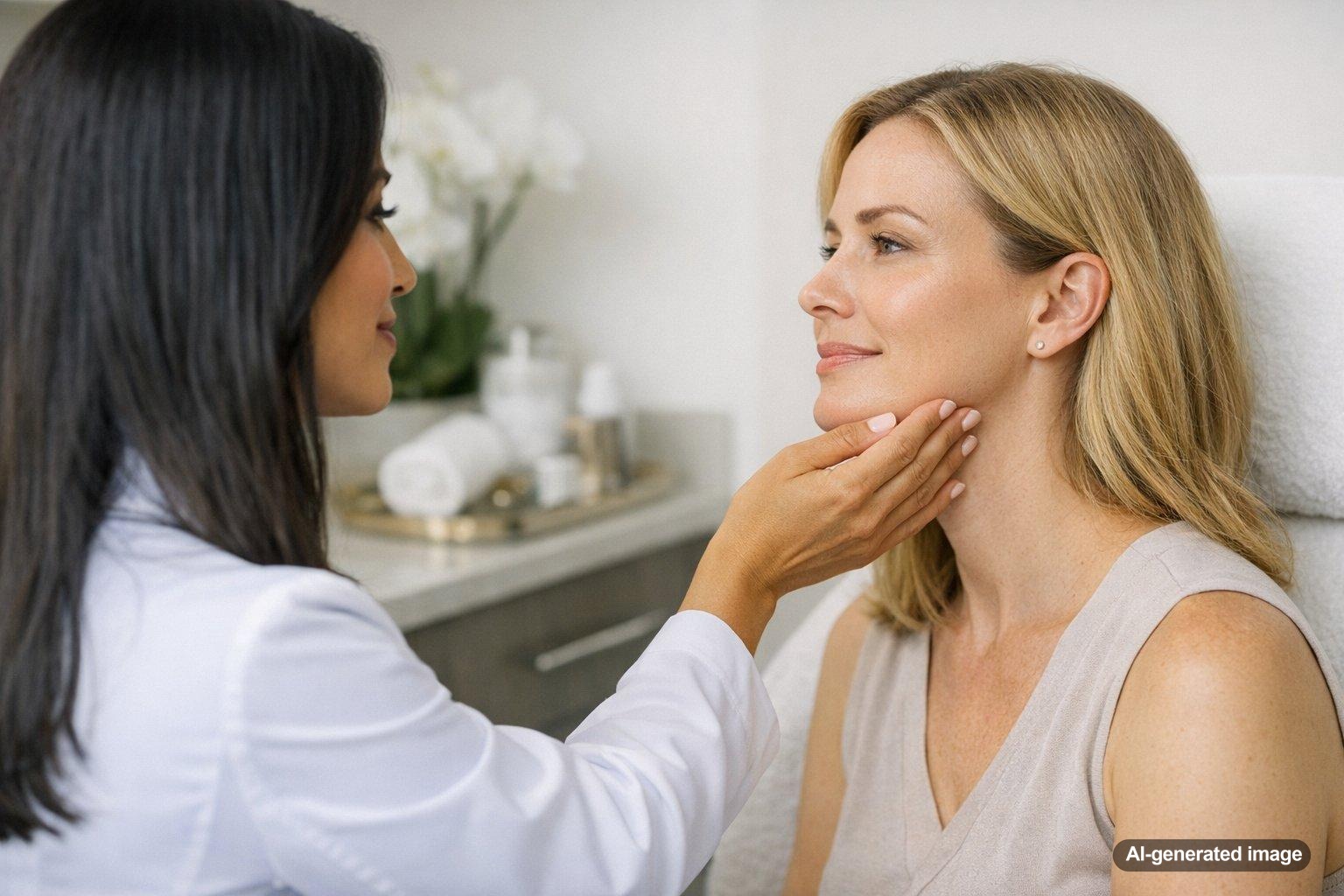
For many people, early heaviness along the lower face is not about one dramatic change. It can appear as a small hollow beside the chin, a softer jawline, or a shadow that makes the lower face look less defined than it once did. In South Florida, where bright light, photos, travel, and year-round social plans are part of daily life, these subtle changes can feel more noticeable.
Radiesse is one non-surgical option that may help support structure in carefully selected areas of the lower face, including the pre-jowl sulcus and jawline. The right approach depends on your anatomy, skin quality, facial balance, and goals, which is why evaluation by a trained dermatology professional matters.
Quick answer
- Radiesse may help soften the appearance of the pre-jowl sulcus when volume support is appropriate.
- It can be used strategically to support jawline definition without surgery in select patients.
- Results vary based on anatomy, skin laxity, age, bone structure, and treatment plan.
- A conservative, balanced approach is often preferred for natural-looking lower face contour.
- A dermatologist can help determine whether Radiesse, another filler, or a different option is more appropriate.
What Radiesse is
Radiesse is an injectable biostimulatory filler used by trained clinicians to provide structural support in specific areas. In aesthetic dermatology, it is often considered when the goal is not simply to fill a line, but to support facial contours in a thoughtful way.
For the lower face, Radiesse may be discussed when there is a visible transition between the chin, jawline, and early jowl area. The pre-jowl sulcus is the small hollow that can develop just in front of the jowl, near the corners of the chin. When it becomes more visible, the jawline can appear less smooth or less defined.
Why the pre-jowl sulcus and jawline can change
Lower face changes are usually multifactorial. They can be associated with natural aging, genetics, sun exposure, changes in facial fat pads, skin laxity, dental or bite structure, and gradual shifts in bone support. Some people notice the area earlier than expected, while others may not see it until later adulthood.
- Volume shifts: Changes in facial volume can make hollows and shadows more noticeable.
- Skin laxity: Looser skin can soften the crisp border of the jawline.
- Bone and chin structure: The shape of the chin and mandible can influence how the lower face ages.
- Sun exposure: South Florida sun exposure can contribute to visible skin aging over time.
- Facial movement: Repeated expression and natural muscle activity may affect how the lower face rests and moves.
What you can do at home
At-home care cannot recreate the structural support of an injectable treatment, but it can help maintain the appearance and quality of the skin. A simple routine is often the most sustainable.
- Use broad-spectrum sunscreen consistently, especially in Fort Lauderdale’s year-round sun.
- Choose gentle cleansing and moisturizing products that support the skin barrier.
- Consider dermatologist-guided ingredients such as retinoids when appropriate for your skin.
- Avoid aggressive facial massage or devices that irritate the skin.
- Stay realistic about topical products: they may support texture and tone, but they do not replace in-office structural treatments.
Professional options
Professional treatment for the pre-jowl sulcus and jawline should be individualized. Some patients may benefit from Radiesse, while others may be better suited for a different filler, collagen-stimulating treatment, skin tightening option, resurfacing treatment, or a combination approach. The goal is to understand what is creating the concern before choosing a treatment.
When Radiesse is used for lower face support, placement, amount, and technique are important. A refined plan may focus on improving facial transitions rather than changing the face dramatically. Many patients prefer a refreshed look that still feels like them.
At Waverly DermSpa, we offer Radiesse and can help you understand whether it may be appropriate.
When to see a dermatologist
Consider seeing a dermatologist if you are unsure whether your lower face concern is related to volume, skin laxity, texture, or another factor. A board-certified dermatologist can evaluate the skin and facial structure, review your medical history, and discuss options in a way that is specific to you.
- You want a non-surgical approach but are unsure which treatment fits your anatomy.
- You have had filler before and want a careful review before adding more.
- You are noticing asymmetry, heaviness, or skin changes that concern you.
- You are pregnant, nursing, have certain medical conditions, or have a history of reactions to injectables.
- You want a conservative plan that prioritizes balance and safety.
FAQ
Can Radiesse help define the jawline without surgery?
Radiesse may help support jawline definition in properly selected patients. It is not a substitute for surgery, and it may not be the right choice for every type of jawline concern.
Is Radiesse used directly in the pre-jowl sulcus?
It can be considered in or around the lower face depending on anatomy and clinician judgment. Treatment planning is individualized because placement strategy affects both appearance and safety.
Will the result look natural?
A natural-looking outcome depends on evaluation, product choice, placement, and restraint. The goal at Waverly DermSpa is a balanced look that respects your facial features rather than an overfilled appearance.
How do I know if Radiesse or another filler is better for me?
A consultation is the best way to compare options. Your clinician can evaluate whether your concern is driven more by volume, skin laxity, facial structure, or a combination of factors.
Is there downtime?
Experiences vary. Some people may have temporary swelling, tenderness, bruising, or redness after injectable treatments. Your clinician can review what to expect and how to prepare based on your treatment plan.
Ready to get help?
Schedule an appointment or send a message and our team will get back to you.
Prefer to call? 954-666-3736
Disclaimer
This article is for educational purposes and is not medical advice. For diagnosis and personalized treatment, please book an appointment with a board-certified dermatologist.
