

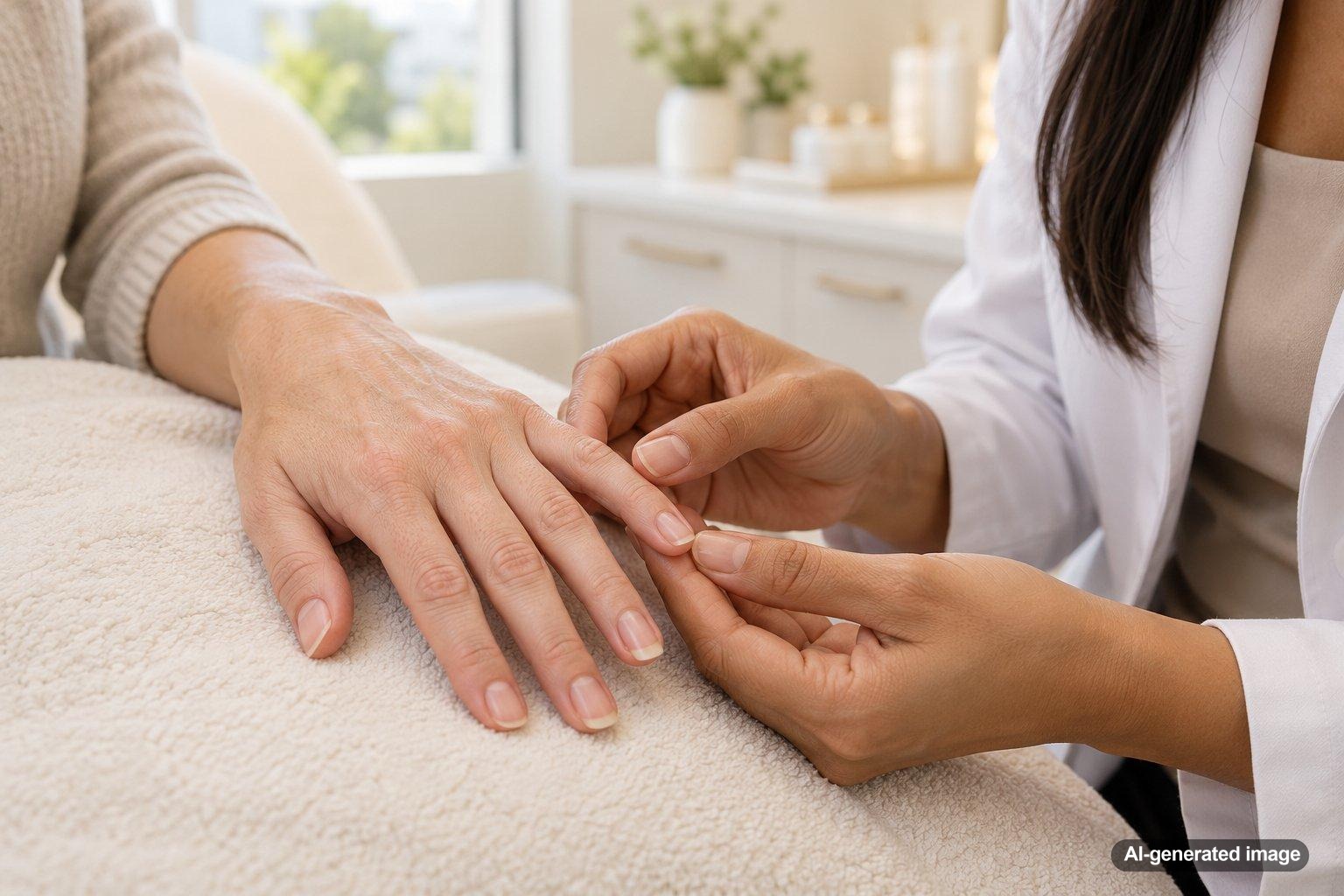
Noticing that one fingernail always seems longer than the others can be surprisingly puzzling, especially when you trim every nail at the same time. In most cases, one nail growing faster than the others reflects normal differences in how individual nails develop, how often fingers are used, and how well each nail retains its growing edge. The difference may be more noticeable on a particular finger, and it does not necessarily indicate a health problem.
Still, nail growth is not identical across every finger. Each nail has its own growth-producing tissue, and local factors can influence how quickly the nail plate advances. Understanding the difference between genuinely faster growth and a nail that simply breaks less often can help explain what you’re seeing and when a change deserves closer attention.
Quick Answer: Why Does One Nail Grow Faster?
- Natural variation: Individual fingernails do not necessarily grow at identical rates, even on the same hand.
- Finger differences: Nail growth can vary by finger, and some people notice more rapid growth on frequently used fingers.
- Local growth conditions: The nail matrix, surrounding tissue, and previous minor injuries can influence nail development.
- Uneven breakage: A nail that stays intact may appear to grow faster than neighboring nails that regularly chip, peel, or split.
- Changes over time: A longstanding difference is generally less concerning than a new growth change accompanied by pain, discoloration, thickening, or distortion.
How Fingernails Actually Grow
Fingernails grow from specialized tissue called the nail matrix, located beneath the skin near the base of each nail. Cells produced in this region gradually become part of the hard nail plate. As new nail material forms, the existing plate moves forward over the nail bed toward the fingertip.
The pale crescent sometimes visible near the cuticle, called the lunula, represents a visible portion of the matrix region. However, much of the matrix is hidden beneath the proximal nail fold. A lunula that is small or difficult to see does not automatically indicate slower growth or unhealthy nails.
Because each finger has its own nail matrix and surrounding anatomy, nails can grow at somewhat different rates. The differences are usually subtle, becoming apparent only after enough time has passed since trimming.
It is also important to distinguish nail growth from nail length. Growth occurs at the base, but the length you see at the fingertip depends on both new nail production and how much of the free edge survives everyday activities.
Common Reasons One Nail May Grow Faster
1. Natural Differences Between Fingers
Individual fingernails naturally vary in growth rate. Research on normal nail development has described differences associated with finger location, age, and other physiological factors. The middle fingernail, for example, may grow relatively quickly in some people, although there is no universal pattern that applies to every hand.
If one nail has consistently grown slightly faster for years and otherwise looks normal, that difference may simply be part of your individual nail-growth pattern.
2. Your Dominant Hand and Everyday Activity
Some observations suggest that fingernails on the dominant hand may grow slightly faster than those on the nondominant hand. Greater finger use and local physiological differences have been proposed as possible contributors, although the exact mechanisms are not fully established.
Typing, writing, cooking, and handling objects also affect nail edges differently. A frequently used finger might experience more minor damage, making its nail look shorter despite ongoing growth. Another finger may retain its free edge more successfully and appear to grow faster.
3. Differences in the Nail Matrix
The nail matrix produces the material that becomes the nail plate. Small anatomical and functional differences between nail matrices can contribute to variation in nail growth and appearance.
A nail that has always been slightly longer or faster-growing than its neighbors may reflect normal local differences. However, a nail that suddenly becomes unusually thick, ridged, distorted, or slow-growing deserves a different level of attention because changes affecting the matrix can alter nail production.
4. Previous Minor Injuries
A finger that has been caught in a drawer, repeatedly pressed against a hard surface, or subjected to ongoing friction may develop temporary changes in nail growth. Injuries near the nail base are particularly relevant because the matrix lies beneath the surrounding skin.
Sometimes a previously injured nail grows more slowly or unevenly, making an unaffected neighboring nail appear unusually fast. The original injury may have been minor enough that you no longer remember it.
Not every nail injury produces lasting changes. The appearance and eventual recovery depend on the location and extent of the injury.
5. One Nail Breaks Less Than the Others
This is one of the easiest explanations to overlook. Imagine trimming all ten fingernails to the same length. Over the following weeks, several nails develop tiny chips from cleaning, opening containers, or repeated contact with hard surfaces. One nail remains smooth and intact.
When you compare them again, the undamaged nail looks longer. It may not have grown faster at all. It may simply have retained more of its original length.
Peeling, splitting, and brittle nail edges can create the same illusion. This is why examining the nail surface and free edge can be just as informative as comparing lengths.
Can Nutrition or Overall Health Make One Nail Grow Faster?
Nutrition and general health can influence nail growth and nail quality, particularly when there are significant nutritional deficiencies or underlying medical conditions. However, these influences often affect multiple nails rather than consistently making a single healthy-looking nail grow faster.
A difference limited to one nail is more likely to prompt consideration of local factors, natural variation, or differences in breakage. That does not mean the location alone can establish a cause.
Taking extra vitamins or supplements is not a reliable way to make one nail match the others. If nutritional concerns are present, a clinician can help determine whether an actual deficiency needs evaluation rather than relying on changes in nail length alone.
Is It Normal for One Nail to Grow Faster for Years?
Yes. A stable difference in nail growth can be entirely normal, particularly when the nail remains smooth, comfortable, and similar in color and shape to neighboring nails.
The most useful distinction is often whether the difference has always been present or represents a noticeable change. A nail that has reliably outgrown the others since you can remember is a different situation from one that recently developed an unusual shape or growth pattern.
Consider the overall appearance rather than focusing exclusively on length. Healthy-looking nails can vary slightly in curvature, thickness, and growth rate without requiring every difference to have a medical explanation.
How to Tell Whether a Nail Is Actually Growing Faster
If you’re curious about a consistent length difference, simple observation may help you separate growth from breakage.
- Trim nails evenly: Start with a similar free-edge length without cutting too close to the skin.
- Observe the same fingers: Compare the nail that appears faster-growing with a neighboring nail on the same hand.
- Look for damaged edges: Small chips, peeling layers, or splits may explain why another nail remains shorter.
- Take occasional photographs: Images taken under similar lighting and positioning can help reveal gradual changes without relying on memory.
- Watch the nail’s overall appearance: Note any new ridges, color changes, lifting, tenderness, or altered shape.
A nail growing from its base cannot be evaluated accurately by measuring the free edge alone. Nail length reflects both production and wear, so home comparisons are approximate rather than diagnostic.
There is no need to repeatedly measure or manipulate an otherwise normal nail. A simple comparison after routine trimming is usually enough to understand whether the pattern seems consistent.
What You Can Do at Home to Support Healthy Nail Growth
Although normal growth-rate differences cannot necessarily be equalized, gentle nail care may reduce breakage and make nails easier to compare.
- Moisturize nails and cuticles: Regular hand cream can help support the surrounding skin and reduce dryness associated with brittle nail edges.
- Use a gentle filing technique: Smooth rough edges before they catch on clothing or other objects.
- Protect hands during wet work: Gloves may reduce repeated exposure to water, cleaning products, and irritation.
- Avoid picking at cuticles: The skin around the nail base helps protect the underlying growth region.
- Limit repeated nail trauma: Avoid using fingernails to scrape labels, pry open containers, or perform other tasks that place pressure on the nail plate.
- Maintain balanced nutrition: Consistent dietary intake supports normal tissue function, although it will not necessarily change the relative growth rates of individual nails.
If your nails are otherwise healthy, the goal is not to force them all to grow at precisely the same speed. It is to maintain comfortable nails with minimal avoidable damage.
When Should You See a Dermatologist About Uneven Nail Growth?
A small, longstanding difference in growth rate without other symptoms is generally less concerning than a newly changing nail. Consider scheduling a dermatology evaluation if you notice any of the following:
- A nail suddenly grows differently or becomes noticeably distorted without an obvious explanation.
- New discoloration appears, particularly a dark streak that is changing, widening, or extending onto surrounding skin.
- The nail becomes unusually thick, brittle, crumbly, or separated from the nail bed.
- Persistent pain, swelling, tenderness, or drainage develops around the nail.
- A new lump, persistent ridge, or unusual growth appears near the nail base.
- One nail progressively changes shape or stops growing while the others remain unchanged.
These findings do not identify a specific diagnosis. They are reasons to have the nail examined rather than assuming the change is simply a difference in growth speed. A rapidly worsening, painful, or severely inflamed nail should receive prompt medical attention.
How a Dermatologist Evaluates Uneven Nail Growth
A dermatologist typically begins by examining the nail plate, nail folds, surrounding skin, and other fingernails. The history of the change is especially helpful: whether it has always been present, appeared after an injury, or developed alongside other symptoms.
Depending on the findings, evaluation may involve a closer examination of the nail surface, assessment for repeated mechanical damage, and questions about work activities, nail products, medications, or relevant health changes.
Additional testing is not automatically necessary. It may be considered when the examination suggests a specific underlying concern. Treatment decisions depend on the cause, and a normal anatomical variation may not require treatment at all.
For patients in Fort Lauderdale, including seasonal residents and visitors who have noticed a new nail change while traveling, bringing a previous photograph can be helpful when the difference developed gradually. Dr. Maryann Mikhail, MD, and the dermatology team at Waverly DermSpa can evaluate nail concerns and discuss appropriate next steps based on the individual findings.
Frequently Asked Questions
Why does my middle fingernail grow faster than my other nails?
The middle fingernail may naturally grow relatively quickly in some people. Differences in nail growth across fingers have been observed, but the pattern is not identical for everyone. If your middle fingernail has always outgrown its neighbors and looks healthy, normal variation may explain it.
Do fingernails grow faster on your dominant hand?
Some observations suggest slightly faster growth on the dominant hand, potentially associated with differences in finger use and local physiology. However, everyday activity also changes how often nail tips chip or wear down. An apparent length difference does not necessarily establish faster production.
Why does one fingernail grow longer even when I cut them all evenly?
That nail may genuinely grow at a somewhat different rate, or neighboring nails may lose more length through ordinary wear and minor breakage. Comparing the condition of the nail edges can help distinguish these possibilities.
Can an injury change how fast one nail grows?
Yes. An injury involving the nail matrix or nearby tissues may affect subsequent nail growth or shape. Some changes are temporary, while more significant damage can have longer-lasting effects. Persistent distortion or an unexplained new change is worth having evaluated.
Does one fast-growing nail mean I have a vitamin deficiency?
Not usually. A single faster-growing nail is not a recognized standalone sign of a particular vitamin deficiency. Nutritional problems can affect nail health, but nail appearance alone cannot determine whether a deficiency exists.
Should I be concerned if only one nail suddenly changes?
A new change involving only one nail deserves attention when it is persistent, progressive, painful, or accompanied by discoloration, thickening, lifting, or an altered shape. A dermatologist can examine the nail and help determine whether further evaluation is appropriate.
The Bottom Line
One nail growing faster than the others is often a normal finding. Individual nail matrices do not function identically, and differences in finger use, minor injuries, and nail breakage can all influence the length you observe after trimming.
What matters most is whether the pattern is stable and whether the nail otherwise looks and feels normal. A consistent difference without other changes is usually less concerning than a newly developing abnormality. If a nail begins changing unexpectedly or develops additional symptoms, a dermatology evaluation can help clarify the cause.
Ready to get help?
Schedule an appointment or send a message and our team will get back to you.
Prefer to call? 954-666-3736
Medical Disclaimer
This article is for educational purposes and is not medical advice. For diagnosis and personalized treatment, please book an appointment with a board-certified dermatologist.
