

Finding an unusual strand of hair can be surprisingly fascinating. Perhaps most of your hair looks ordinary, but a few individual strands appear flattened, twisted, or folded along their length, almost like a narrow ribbon that someone has gently turned between their fingers. You might notice the difference while brushing, examining a shed hair, or looking closely at a strand under bright light.
Sometimes this appearance reflects normal variation in hair texture. In other situations, a ribbon-like twist can be associated with a structural difference in the hair shaft, including a condition called pili torti. The important distinction is whether the hair is simply shaped differently or is unusually fragile, breaking easily, or appearing alongside changes in the scalp.
Quick Answer: Why Do Some Hairs Look Like Twisted Ribbons?
- Natural variation: Individual hair strands can differ in shape, diameter, curvature, and the way they reflect light.
- Hair shaft twisting: Some hairs develop flattened sections that rotate along the strand, creating a ribbon-like appearance.
- Pili torti: This is a specific hair shaft abnormality involving flattened, twisted segments that may be more fragile than ordinary hair.
- Physical or chemical stress: Repeated heat styling, chemical processing, and friction can change the appearance and strength of hair fibers, although these changes do not necessarily indicate pili torti.
- Scalp-related changes: Occasionally, altered hair growth or twisting is associated with changes affecting the hair follicle and surrounding scalp.
A few unusual strands do not automatically indicate a medical problem. However, a dermatologist can help distinguish harmless texture differences from hair shaft abnormalities when the appearance is new, widespread, or accompanied by breakage.
What Does Ribbon-Like Hair Actually Mean?
A hair strand is not always a perfectly round, uniform cylinder. Its cross-sectional shape, internal structure, and curvature contribute to whether it appears straight, wavy, curly, or irregular.
When people describe a hair as looking like a twisted ribbon, they may be noticing several different features. The strand might appear wider from one viewing angle and narrower from another. It might reflect light unevenly, producing alternating shiny and darker areas. Alternatively, it may visibly rotate around its own length rather than forming the familiar curves of curly hair.
These distinctions matter because a curled strand and a twisted hair shaft are not necessarily the same thing.
Curly hair bends or coils along its length. A twisted hair shaft may rotate around its own longitudinal axis, sometimes with flattened portions that make the rotation more noticeable.
Looking at a strand with the naked eye is not always enough to identify which process is responsible.
Could It Be Pili Torti?
One recognized explanation for genuinely flattened, ribbon-like hair twists is pili torti, a structural abnormality of the hair shaft.
In pili torti, portions of the hair fiber are flattened and twisted around the strand’s long axis. The twisting can occur at irregular intervals, sometimes in clusters. Under magnification, the affected hairs may resemble narrow ribbons that repeatedly turn over themselves.
Because the twisted sections can be structurally vulnerable, affected hairs may be unusually brittle. Some people notice that their hair breaks before reaching its usual length or that certain areas seem persistently short, coarse, or uneven.
Pili torti can be inherited or acquired. Inherited forms may become apparent during childhood, while acquired forms can develop later in life and may affect a more localized area.
However, a ribbon-like strand is not enough to establish a diagnosis of pili torti. Confirmation generally requires examination of the hair shaft using magnification, such as trichoscopy or microscopy. Other hair shaft changes can look similar without having the same significance.
Why Might Only Some of Your Hairs Be Twisted?
It is possible for unusual hair shafts to appear among otherwise typical strands. Hair follicles do not always produce identical fibers, and changes may affect individual follicles or small regions rather than the entire scalp.
Several possibilities can help explain why only certain hairs look different.
- Differences between follicles: Neighboring follicles may produce strands with somewhat different diameters, shapes, or growth patterns.
- Localized hair shaft abnormalities: Some structural differences affect only a subset of hairs.
- Changes during regrowth: Newly growing hairs can temporarily look different in length, curvature, or texture from surrounding strands.
- Uneven styling exposure: Hair around the face, part line, or crown may experience different amounts of heat, tension, brushing, or chemical processing.
- Changes affecting particular follicles: In some acquired hair shaft disorders, changes around the follicle can alter the structure of the emerging strand.
The number of affected strands, their location, and whether the pattern is changing over time all provide useful context.
Can Heat Styling or Hair Products Cause Ribbon-Like Twists?
Heat and chemical processing can alter the physical condition of hair, especially when exposure is repeated or intense. Flat irons, curling tools, bleaching, chemical straightening, and other treatments may weaken the protective cuticle or damage the underlying hair fiber.
Damaged strands can develop rough surfaces, splits, irregular bends, and areas that reflect light differently. Some may appear distorted or twisted when examined closely.
Still, it is important not to confuse general hair damage with a specific structural disorder. Heat-related damage does not automatically mean pili torti. The two can have different underlying mechanisms, and appearance alone cannot reliably distinguish them.
If unusual hairs are concentrated in areas that receive frequent styling, reviewing those habits may be worthwhile. If the twisting appears near the roots of newly grown hair, continues despite gentler handling, or occurs with scalp symptoms, a dermatologic examination may be more informative.
Does Twisted Hair Mean Your Hair Is Unhealthy?
Not necessarily. Hair has considerable natural diversity, and a strand that looks unusual is not automatically defective or unhealthy.
The more useful question is whether the unusual appearance is accompanied by signs of weakness or changes in hair growth.
For example, a strand that has always grown with an unusual curve but remains flexible and strong is different from one that repeatedly breaks at flattened or twisted points.
Signs that deserve closer attention include:
- Numerous short, broken hairs appearing in the same area.
- Increasing difficulty growing hair beyond a certain length.
- Hair that feels unusually rough or brittle despite gentle care.
- Noticeable thinning or changes in hair density.
- New redness, scaling, tenderness, itching, or other scalp changes.
These findings do not identify one particular condition, but they can help a dermatologist determine whether further evaluation is appropriate.
What Can You Do at Home?
If you notice a few ribbon-like hairs without other concerning symptoms, gentle hair care is a reasonable starting point.
Reduce unnecessary heat exposure
Consider lowering the temperature of heated styling tools, limiting repeated passes over the same sections, and allowing hair to air-dry when practical. A heat-protectant product may help reduce some styling-related damage, but it cannot eliminate the risks associated with excessive heat.
Handle fragile strands carefully
Avoid forceful brushing, aggressive detangling, and repeated pulling. Conditioner and appropriate detangling products may make strands easier to separate with less friction.
Avoid unnecessary chemical processing
If your hair seems increasingly brittle, consider spacing out coloring, bleaching, or chemical straightening services. Existing structural damage in the visible hair shaft generally cannot be biologically repaired in the way living skin tissue heals.
Pay attention to the pattern
Notice whether the twisted strands have always been present or appeared recently. It may also help to observe whether they occur throughout the scalp or predominantly in one location.
If you find an unusual shed strand, you can save it for a dermatologist to examine. There is no need to repeatedly pull out hairs or inspect every strand.
Be cautious with supplements and treatments
A twisted appearance alone does not establish a nutritional deficiency. Hair supplements and scalp treatments are not appropriate substitutes for identifying the reason a hair shaft has changed. Discuss persistent concerns with a qualified clinician before beginning targeted treatments.
How Can a Dermatologist Evaluate Ribbon-Like Hair?
A dermatologist may begin by asking when the unusual hairs appeared, whether they break easily, and whether there have been changes in hair care, medications, or scalp health.
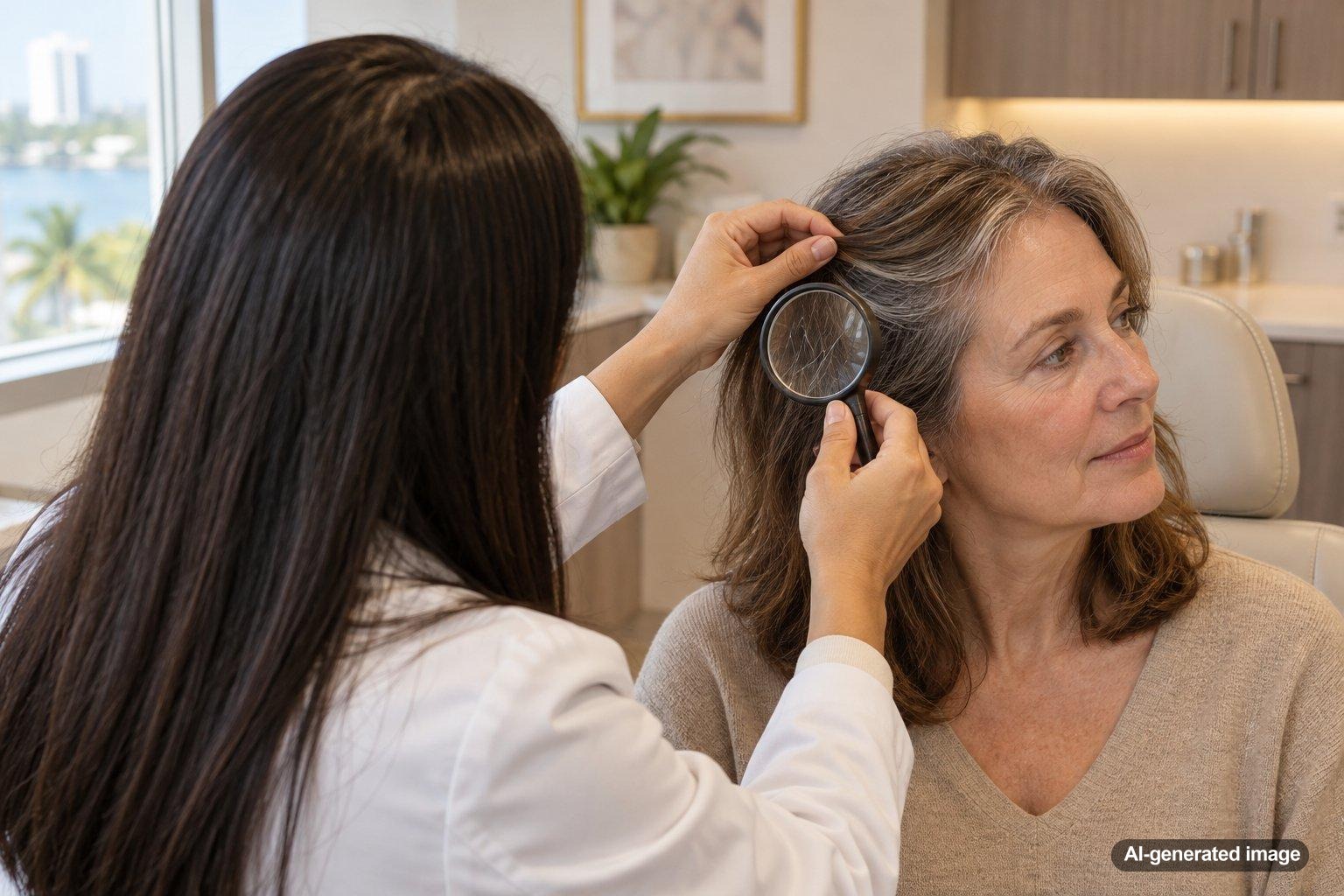
The examination may include looking closely at the affected area and assessing the hair shafts under magnification.
Trichoscopy is a noninvasive technique that uses magnification to examine the hair and scalp. It can reveal structural details that are difficult to appreciate with the naked eye, including twisting, breakage patterns, and changes around hair follicles.
In selected cases, microscopic examination of individual strands may help characterize a suspected hair shaft abnormality.
If the examination suggests an underlying scalp disorder or another medical condition, additional evaluation may be recommended based on the findings. Extensive testing is not automatically necessary for someone who simply notices a few unusual strands.
The approach depends on whether the issue is primarily cosmetic, related to hair fragility, or part of a broader change in scalp health.
Are There Professional Treatment Options?
There is no single treatment appropriate for every person with twisted or ribbon-like hairs. Management depends on the reason the strands developed that appearance.
If the issue is related to external hair damage, reducing further injury and adjusting hair care practices may help protect newly growing hair.
When a structural abnormality such as pili torti is confirmed, care often focuses on minimizing breakage and evaluating whether an associated condition requires attention.
If an underlying scalp disorder is identified, a dermatologist can discuss whether medical treatment is appropriate. Any prescription therapy or procedure should be selected according to the specific diagnosis rather than the appearance of individual strands.
It is also important to distinguish hair shaft fragility from conditions that primarily affect hair density or follicle activity. Treatments intended for certain types of hair loss do not necessarily correct the structure of a twisted hair shaft.
When Should You See a Dermatologist?
Consider scheduling an evaluation if ribbon-like twisting is new, becoming more noticeable, or associated with other changes in your hair or scalp.
Particularly useful reasons to seek an appointment include:
- Persistent or increasing hair breakage.
- Visible thinning, patchy hair loss, or reduced hair density.
- Scalp redness, persistent scaling, pain, or tenderness.
- Areas where hairs remain unusually short or fail to grow as expected.
- Changes in hair texture that develop without an obvious explanation.
- Unusual hair fragility in a child, especially when accompanied by other developmental, skin, nail, or hearing concerns.
These symptoms can have several explanations and do not necessarily indicate a serious condition. Earlier evaluation is especially worthwhile when hair loss occurs alongside persistent scalp inflammation or other signs suggesting possible follicular damage.
Frequently Asked Questions
Why does one strand of my hair look flat and twisted?
A single unusual strand may reflect natural variation in hair shaft shape, previous physical damage, or a structural difference in the fiber. A persistently flattened strand with repeated twists may resemble pili torti, but magnified examination is needed to determine whether that condition is present.
Is ribbon-like hair the same as curly hair?
No. Curly hair bends or coils along its length, while ribbon-like twisting may involve rotation of a flattened hair shaft around its own axis. Some strands can have both curvature and twisting, so the appearance can overlap.
Can pili torti develop in adults?
Yes. Although some forms are inherited and appear early in life, acquired pili torti can occur later. Depending on the circumstances, it may be associated with changes affecting the follicle or other underlying factors. A dermatologist can assess whether the finding is isolated or warrants additional investigation.
Will cutting off twisted hairs make them grow back normally?
Trimming removes the visible portion of the hair but does not change how the follicle produces new growth. If the unusual shape results from damage along the existing shaft, newly growing hair may look different once the damaging exposure is reduced. If the shape originates within the follicle, trimming alone will not address the underlying cause.
Does having twisted hairs mean I am losing my hair?
Not necessarily. Some people notice unusual strands without meaningful hair loss. However, certain twisted hair shaft abnormalities can increase fragility, causing strands to break and making the hair appear thinner or shorter. A dermatologist can help distinguish breakage from hair shedding or reduced follicle activity.
Can a dermatologist tell whether my hair is naturally twisted or damaged?
Often, a dermatologist can narrow down the possibilities by examining the strands and scalp, reviewing your history, and using trichoscopy or microscopy when appropriate. Occasionally, further assessment is needed to understand why the hair shaft has changed.
The Bottom Line
A hair that twists like a ribbon is not automatically a sign that something is wrong. Individual strands can vary naturally, and styling-related damage can also create unusual shapes. In some cases, however, flattened and repeatedly twisted hairs reflect a recognizable hair shaft abnormality such as pili torti.
The most important clues are whether the appearance is new, whether the strands break easily, and whether there are accompanying changes in hair density or scalp health. A dermatologist can examine the hair shaft and help determine whether simple protective care or a more detailed evaluation is appropriate.
Ready to get help?
Schedule an appointment or send a message and our team will get back to you.
Prefer to call? 954-666-3736
Disclaimer
This article is for educational purposes and is not medical advice. For diagnosis and personalized treatment, please book an appointment with a board-certified dermatologist.
Sources & further reading
- DermNet – Defects of the hair shaft
- DermNet – Trichoscopy of Genetic Hair Shaft Disorders
- DermNet – Trichoscopy
